
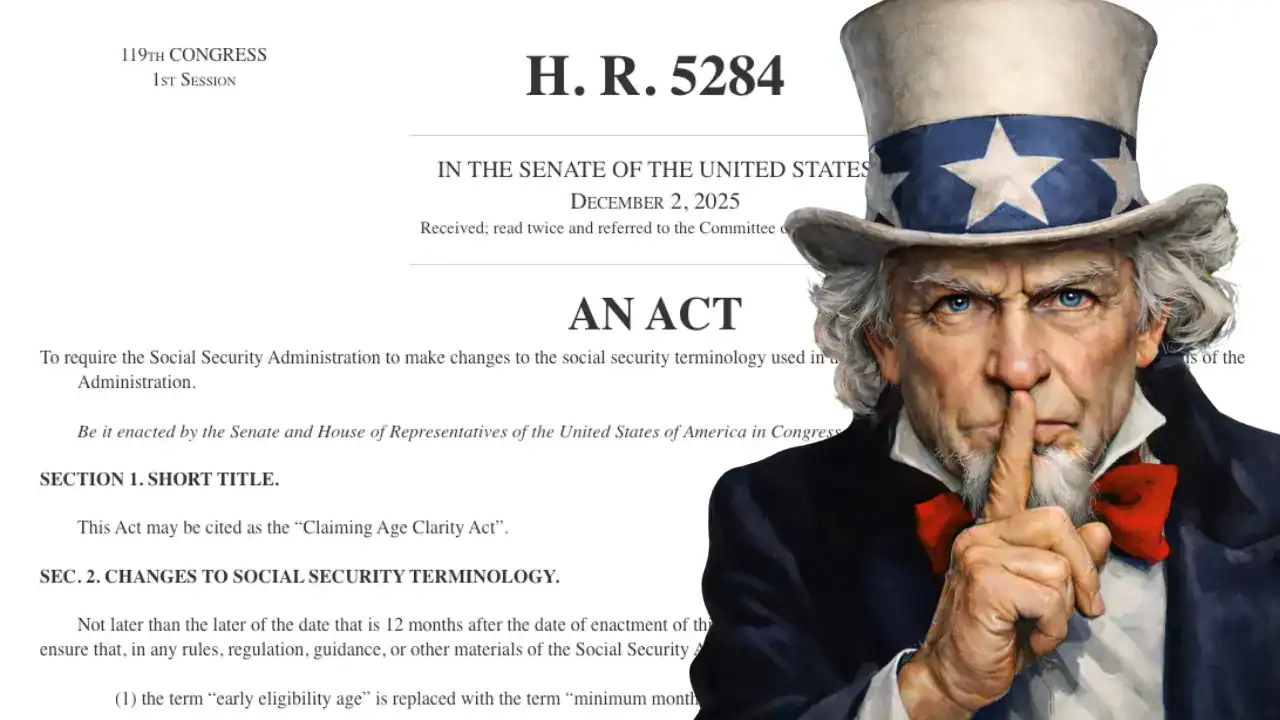
A few weeks ago, the Claiming Age Clarity Act quietly passed the House. It’s now sitting in the Senate.
Almost no one is talking about it.
At first glance, it looks minor. It doesn’t increase taxes. It doesn’t reduce benefits. It doesn’t change the structure of Social Security.
All it does is rename a few terms.
But when lawmakers start rewriting the vocabulary around retirement, it’s worth paying attention.
Because words shape behavior. And behavior shapes outcomes.
Let’s look at what this bill would actually do.
What Is the Claiming Age Clarity Act?
The Claiming Age Clarity Act would change three commonly used Social Security terms:
- “Early eligibility age” would become “minimum monthly benefit age.”
- “Full retirement age” would become “standard monthly benefit age.”
- The term “delayed retirement credit” would no longer be used. Age 70 would instead be called the “maximum monthly benefit age.”
That’s it.
No change to benefit formulas. No change to claiming ages. Just new labels.
On the surface, it feels harmless. Almost pointless.
But it’s not pointless.
Why Changing the Language Matters
Let’s think about how these terms feel.
“Early eligibility age” sounds neutral. Early isn’t inherently negative. It feels like an option.
But “minimum monthly benefit age” feels very different. It suggests you’re taking the smallest check available.
“Full retirement age” sounds like a finish line. You’ve reached the full amount. It carries a sense of completion.
But “standard monthly benefit age” feels average. Ordinary.
And “delayed retirement credit” sounds like a tradeoff. You’re delaying and hoping it pays off.
But “maximum monthly benefit age” sounds like the smart move. The disciplined move. The optimal move.
Same math. Different psychology.
Language reframes decisions.
Is This Preparing Us for Bigger Changes?
Here’s why this matters.
If lawmakers eventually raise the full retirement age, the transition becomes easier if the terminology has already changed.
Right now, full retirement age is 67 for anyone born in 1960 or later.
Most serious reform proposals include gradually increasing that age to 68, 69, or even 70 over time.
The Congressional Budget Office has estimated that raising the full retirement age alone could fix roughly one-third of Social Security’s long-term funding shortfall.
That’s not trivial.
But politically, raising the “full retirement age” sounds like cutting benefits. It feels like moving the finish line.
If instead we’re talking about adjusting the “standard monthly benefit age,” it feels less dramatic.
That distinction matters in Washington.
The Logical Case for Raising the Retirement Age
To be fair, there is a reasonable argument for increasing the retirement age.
When Social Security began paying benefits in 1940, a 65-year-old man lived to around 76 on average.
Today, that number is over 84. For women, it’s closer to 87.
We’re paying benefits for significantly longer than the system was originally designed to support.
From a purely mathematical standpoint, something has to adjust:
- Taxes increase
- Benefits decrease
- The retirement age rises
- Or some combination of all three
Raising the retirement age is politically painful, but financially effective.
The Real Impact on Early Claimers
Here’s where it becomes tangible.
Today, if your full retirement age is 67 and you claim at 62, you receive about 70% of your full benefit.
If the retirement age gradually moved to 70 and someone still claimed at 62, that percentage would drop closer to 55%.
That’s a major reduction.
And that’s how raising the retirement age improves system finances — by paying out less over time.
Whether you call it a cut or an adjustment, the outcome is the same: smaller checks for those who claim early.
What This Means for You
First, don’t panic. Nothing has changed yet.
Second, don’t make claiming decisions based on political speculation.
But do understand this: Social Security reform is coming. The trust fund math makes that clear. The only real debate is what combination of changes will be used.
If the vocabulary is changing now, it may signal that policymakers are laying groundwork for broader reform discussions.
The real questions ahead will be:
- How far will the retirement age rise?
- How quickly will it happen?
- Will protections exist for those physically unable to work longer?
The Claiming Age Clarity Act may look small. But small changes in language often precede big changes in policy.
When lawmakers start redefining the finish line, it’s worth watching where they’re about to move it.